

Two years ago I pondered what was next for UK insurance distribution. Unfortunately, there has not been a material shift, but there is certainly an emerging one now. This time, I put the question to Tim Graham, the founder and leader of Marrow, the team behind the Aviva app in ChatGPT.
In this conversation
Sherdin Omar, Director, Pebblesfs
Tim Graham, founder, Marrow
Sherd: PCWs remain the dominant distribution channel, and brokers remain a significant force, deftly meeting customer needs. I consider embedded insurance standard when you lease or buy a new car, but I do believe embedded insurance has untapped potential. Products remain the same: there is some growth in telematics in motor (Allianz and Ticker, October 2025), and new entrants in home have generally targeted underserved customer segments. But there’s not been any material change. My thinking is that for products to differentiate, distribution must be disrupted, which I think is happening now.
Sherd: AI agents are seemingly everywhere now, firmly meeting the standard customers’ core demand: ‘make my life easier’.
The FCA commissioned Mills Review (July 2026) is a hefty read at over 100 pages. The first line sums it up: “AI will transform retail financial services by 2030 and beyond”.
One piece of research that stood out, based on 5,026 consumers, shows people already using AI for complex products like debt advice, investing and pensions, where they need guidance to close the information gap. It is not a stretch to believe that as confidence in AI grows, consumers will adapt their shopping behaviour.
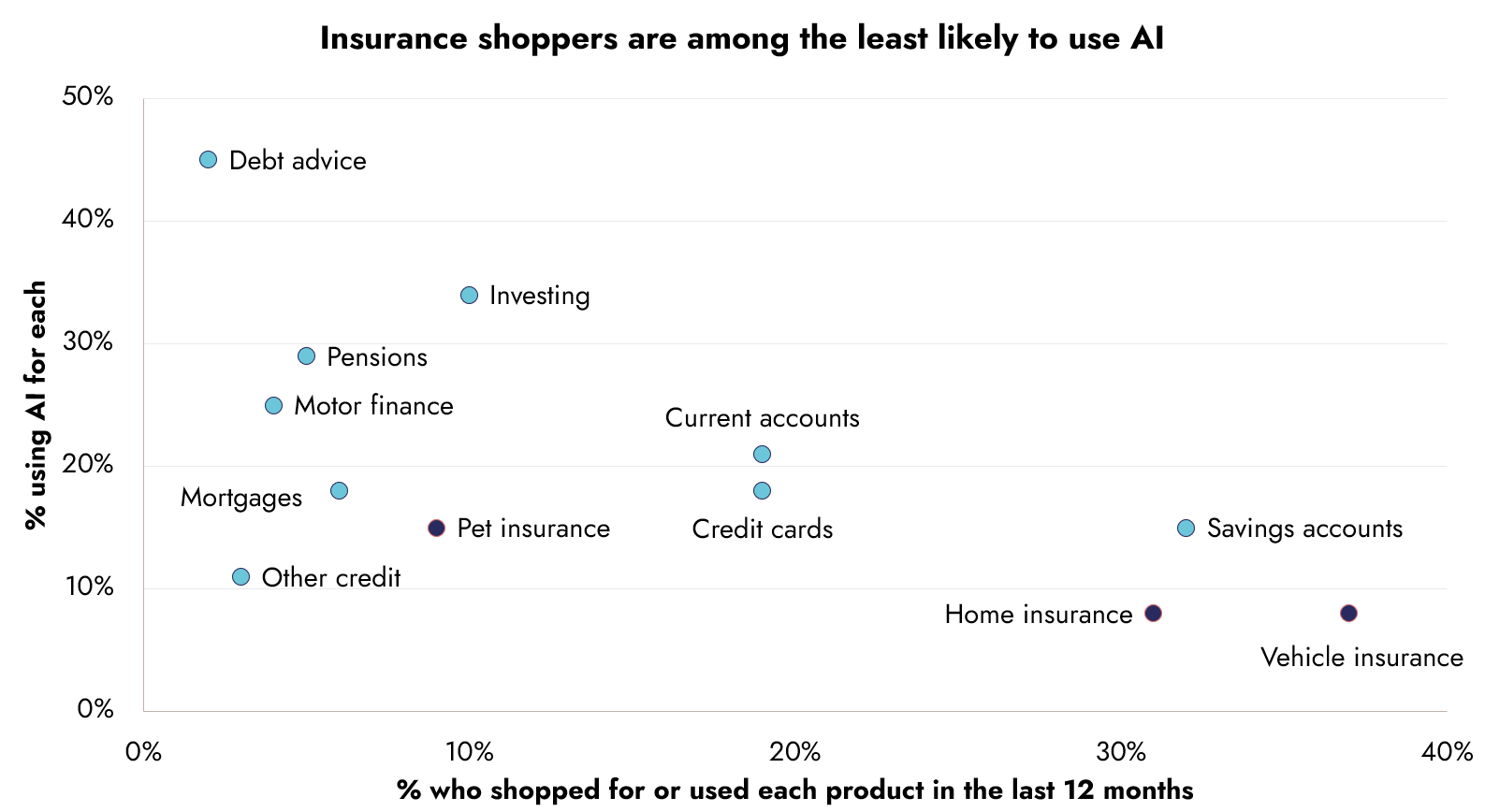
Sherd: The success of PCWs has reduced retail insurance to a single dimension: price.
Brand, service and trust all support the customer’s decision, but the focus is primarily on price. Now I think agentic AI could upset this balance, and rapidly transform distribution back to a place where brand, service and trust matter just as much as price.
And if the past 40 years of retail insurance are any guide, when distribution changes, insurers (eventually) adjust their products to catch up. But AI requires insurers to adjust their products rapidly, and it can also help speed up product design.
I put this provocation to Tim Graham, founder of Marrow, the team behind the Aviva app in ChatGPT.
Tim: Absolutely agree. An AI agent can take all the friction away and find the best fit based on the customer’s criteria. But for agentic AI to become the go-to channel, there are barriers to overcome.
Sherd: Changing behaviour is hard. Just ask anyone who’s (or is trying to) quit smoking. My worry is that the customer does the research in an AI agent, even makes the decision there, but then defaults back to a PCW to buy.
Tim: I see this one a bit differently. I don’t think the customer is necessarily the source of inertia. The Mills Review’s own research has around a quarter of UK adults willing to trust a general-purpose assistant with a financial decision, and one in five happy for it to act for them within limits they’ve set.
Sherd: So why isn’t that turning into premium yet?
Tim: The obstacles are mostly technical and structural, and they’re changing fast. Until recently, you couldn’t get the thing consumers go to PCWs for, prices, in any consumer AI agent. Now, through plug-ins and headless browsing agents like Muse and Instinct, your average consumer is increasingly likely to have tools that let them see a series of prices and form a view.
There’s still some way to go before the breadth is there for consumers to judge how competitive a quote is. But that’s coming.
Sherd: Insurers will need to build a presence in agentic AI, and that will change how they do business across all departments.
Pricing: if the agent’s recommendation is the key decision factor, real-time price testing, and so price optimisation, will probably give misleading results. And pricing will need to align to product feature values.
Tim: Some things change, but not necessarily fundamentally. In an agent channel, the agent asks on the customer’s behalf, in a structured form, and expects a structured answer back. So there’s an opportunity to design and optimise for a standard purchasing flow.
Price is still, and always will be, important. But so is everything else the agent can get its hands on: the excess, the limits, what’s excluded, how claims are paid and how long they take. Insurers whose product facts are clear and machine-readable are more likely to be cited, and recommended.
Sherd: Underwriting: I would expect policy wordings to simplify, so an AI model doesn’t pick out inconsistencies or challenge complicated terms. The upside is that insurers can compete on brand, trust and product features, more like a consumer retail market.
Tim: I agree, with one addition. Pretty much any model already reads policy documents, and will happily tell the customer when the summary and the wording disagree. So tidying those up matters whether or not you’re bought into the agent channel – and organisations keeping an eye on their web traffic can probably see this already.
There’s an inherent risk too, of course. However good the agent is, it can and will get confused between product versions and terms – so we need to bring more structure to how that conversation is orchestrated.
Sherd: Distribution: ‘Direct’ and ‘intermediary’ teams will need to merge as AI agents blur the lines, and work closely with underwriting to get the right products highlighted.
Tim: Who owns this channel, and how. Many insurers haven’t solved that yet. It’s not conventional distribution, it brings novel risks, and it’s often deeply technical. Getting your house view clear on who owns how your products show up in AI, and how they own it, is critically important.
Sherd: For me, the big question is whether an AI agent can buy on the customer’s behalf, or will stay a research tool.
The worst-case scenario is an agent that scans the market regularly and switches the policy at any point in the year because it’s found a better deal (accounting for any fees). That would create carnage for insurance.
Tim: That’s much more real than it was a few months ago. If you’ve spent any time on LinkedIn recently, you’ll have seen a lot of discussion about Muse, Instinct, etc. Shopping around for insurance is one of the main use cases people have been exploring, for all the reasons we’re discussing: insurance is expensive, not well understood and hard to shop for.
Sherd: But eventually, once the agent can complete the transaction on the customer’s behalf, that could lead to my nightmare scenario: auto-switching policies.
Tim: That’s more of an open question. Even if the agent does a lot of the legwork, it’s still not a hassle-free task for the consumer. My gut feel is that behaviour will take a while to spread, in the UK at least.
That said, agentic services like Nous already do exactly this job in energy and broadband, and insurance is squarely in their sights. So I might be too bearish. What’s certain is that when heavily agent-driven switching arrives, you’ll quickly be out of the picture if your products aren’t available, optimised and well governed in agent channels.
Sherd: Regulation is normally late to the party, but this time the FCA appears to be on the front foot. It agrees that AI will transform financial services, and is actively working with the industry on oversight and controls so consumers get good outcomes.
Tim: For me, this is the most interesting part. There are still unanswered questions, as the Mills Review and others point out. But the Review recommends against new AI-specific rules and says Consumer Duty already covers it. I think that’s right: we can extrapolate from existing principles to work out what a safe experience looks like, and make sure the right level of prudence and consumer protection is in place. That’s not at all straightforward in this channel though: what’s missing is the tooling to live up to those principles at the scale we’re describing, and to prove it’s happened.
Sherd: Yes, I see that as an issue in pricing, where more and more complex models are being built, often without the tooling to ensure the guards are in place.
Tim: The Review calls the model where customers bring their own agent the best one for consumers. In the same breath, it says that depends on data access, interoperability, identity, mandates, liability and audit. Without those foundations, it warns, agents “may remain partial, fragmented or unsafe”.
That foundation has to be built as an industry. An agent that has to learn fifty different ways to ask for a home quote won’t bother, or won’t do it reliably.
Sherd: I know you’re heavily involved in that. Can you share some details?
Tim: Yes. We’re drafting open standards for this at Marrow: what an agent asks, what it gets back, and how consent travels with the request. It’s early, but we have drafts in refinement. It’s exactly the kind of structure we need as an industry to meet the rightly stringent bar for demonstrating consumer safety.
Sherd: Retail insurance will change radically over the next decade, and once again it will be distribution-led. The key question is whether the industry embraces the change, or repeats what happened when PCWs gained traction: adjusting the existing operating model to fit the new channel, without fundamentally changing it.
What do you think: will AI agents become the go-to channel, or another research tool? Join the conversation on LinkedIn.